

My parents were both teachers. They worked hard, but work had boundaries. When they came home, they were home. Evenings belonged to the family. Saturdays and Sundays were usually free. They had nearly two months of summer holidays every year.
Then I entered the Indian IT industry. The boundaries disappeared.
Long hours became the norm. In fact, they were expected. Calls with customers in the US and the UK stretched into the night. Weekend work was part of the job. Nobody questioned it because everyone around us was doing the same thing.
The people who could endure it the longest were often admired.
When you’re twenty-five, it doesn’t feel like a problem. You recover quickly. You sleep less. You work through the night. You tell yourself this is the price of building a career.
I believed that too.
For almost two years I worked night shifts. By the end of it, my eyesight had weakened noticeably. Sometimes my hands would tremble when I stretched them out. I never thought much about it. It simply felt like one of those sacrifices you made if you wanted to get ahead.
The interesting thing about those sacrifices is that they rarely become expensive immediately. The bill arrives years later.
Around the age of thirty-five or forty, many people enter the most exciting stage of their careers. They’re becoming architects, directors, senior directors, or moving toward executive leadership. The opportunities they’ve been working toward for fifteen years are finally within reach.
At almost the same time, what the job demands from you begins to change.
Work becomes less physical and more cognitive. You’re expected to make better decisions, influence more people, and deal with greater ambiguity. Outside work, children are growing up, parents are getting older, and financial responsibilities become heavier.
Your career demands more from you just when your body quietly starts offering less.
I’ve seen this happen often enough that it no longer feels like coincidence.
People who were once able to work twelve-hour days without thinking about it begin talking about poor sleep, weight gain, diabetes, high blood pressure, chronic fatigue, and stress that never quite goes away.
None of those things arrive overnight. They creep in slowly enough that we mistake them for getting older.
A few months ago I was reading Hacking Capitalism by Kris Nova. She argues that endurance isn’t really about how much you can exert. It’s about how well you replenish.
She isn’t alone. Dr. Vivek Murthy, the 19th and 21st Surgeon General of the United States, made a similar point in his commencement address at the University of Arizona:
The heart operates in two phases: Systole, where it pumps blood to the vital organs, and diastole, where it relaxes. Most people think that systole is where all the action is and the more time in systole the better. But diastole—the relaxation phase—is where the coronary blood vessels fill and supply life-sustaining oxygen to the heart muscle itself. Pausing, it turns out, is what sustains the heart.
Michael Phelps made a similar observation in an interview with Tim Ferriss:
For me to be able to do everything I need to do—from playing golf to having enough energy for my kids and everything else that matters—I have to recover.
When we’re young, we think career success belongs to the people who can keep pushing.
Maybe it belongs to the people who know when to pause.
We celebrate exertion because it’s visible. We rarely celebrate recovery because it looks unproductive.
Going for a walk doesn’t look like career development. Neither does sleeping seven hours a night. Neither does spending an evening with your family, reading a book, meeting a friend, praying, exercising, or pursuing a hobby that has nothing to do with work.
Yet these may be the very things that make a thirty-year career possible.
Eating well, sleeping enough, and staying fit aren’t separate from a career. They’re part of what makes a long career possible.
The professionals who sustain excellence over decades are not necessarily the ones who worked the hardest in their twenties. They’re the ones who arrive in their forties with enough physical and mental capacity to take on even bigger responsibilities.
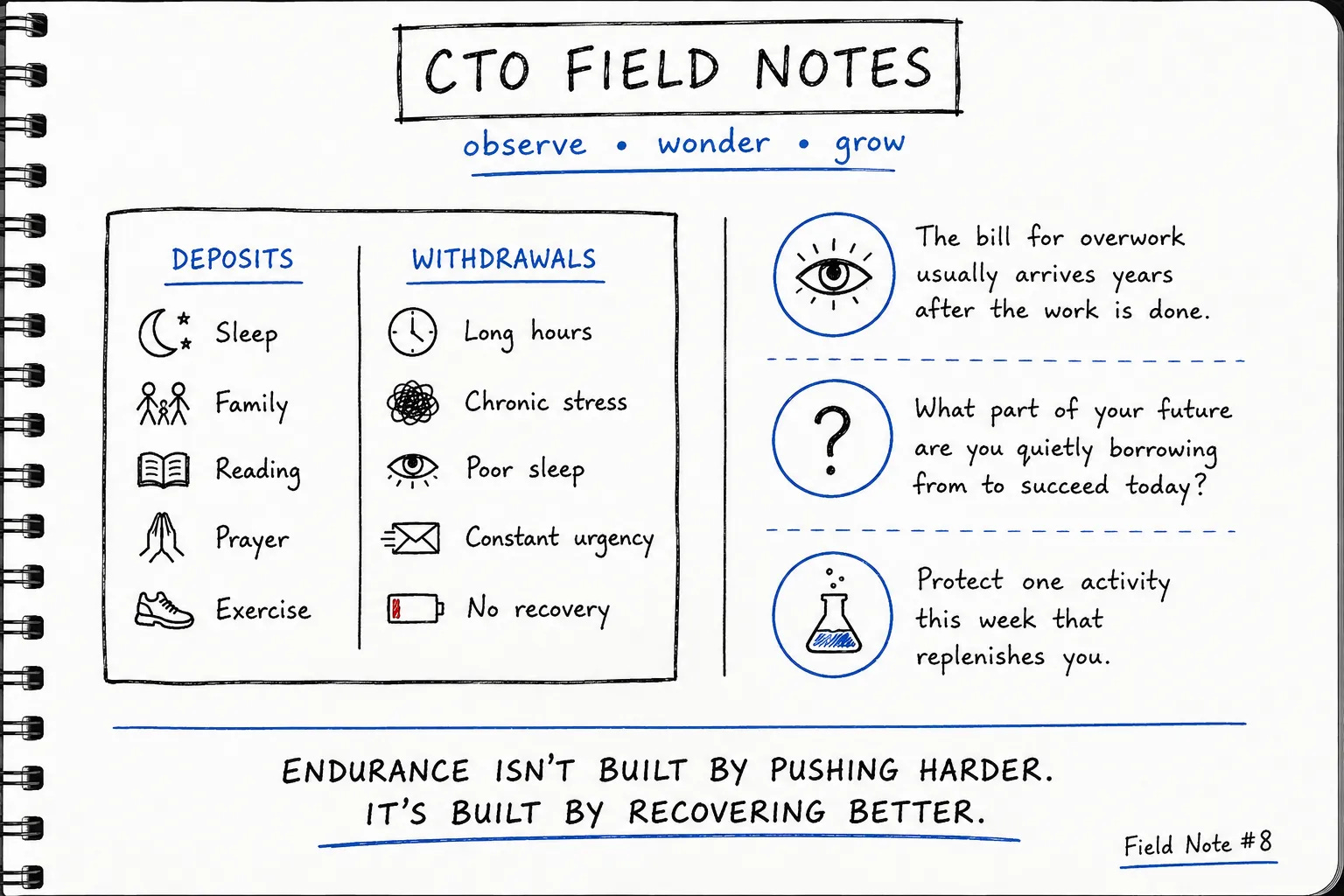
Perhaps endurance was never about pushing harder.
Perhaps it was always about recovering better.
Field Notes
Observation
The bill for overwork usually arrives years after the work is done.
Question
What part of your future are you quietly borrowing from to succeed today?
Experiment
Protect one activity this week that replenishes you. Treat it as seriously as your most important meeting.