

One of the biggest career mistakes I see is people trying to become irreplaceable in their current job.
When you’re the only person who understands a system, a customer, or a critical process, it feels like you’ve built a career moat. The project needs you. The company can’t afford to lose you.
Congratulations. You may have just reduced your chances of getting promoted.
You’ve become too valuable to move.
That sounds counterintuitive, but I’ve seen the opposite work throughout my career.
Whenever I took ownership of a role, I made it a habit to document what I knew. I shared my knowledge freely, not just what I knew, but how I thought through problems and made decisions. More importantly, I looked for someone who could eventually take over my responsibilities.
I wasn’t doing it because I wanted to leave the company.
I was doing it because I wanted to keep growing within it.
Looking back, this habit followed me from developer to consultant, from consultant to an e-governance advisor, and eventually to CTO. I don’t claim it was the only reason those opportunities came my way. But I do believe it made each transition easier. Every time I moved into a new role, someone else was already capable of carrying much of what I had been doing.
Over the years, I’ve come to believe something simple: Organizations don’t promote people because they’re indispensable. They promote people because they’re movable.
Your next promotion often depends on whether someone else can do your current job.
Whenever I explain this, the first question I get is, “If I teach someone everything I know, won’t they replace me?”
It’s a reasonable fear. But in my experience, it happens far less often than people imagine.
Yes, people resign. They move to another team. Sometimes the person you’ve invested in isn’t around when the opportunity comes. Those risks are real.
But over the long run, organizations are far more willing to promote someone who has already built the next layer of capability than someone who leaves a vacuum behind.
When I started learning about stock market investing, I came across something Charlie Munger often talked about: inversion.
Instead of asking, “How do I become indispensable?”, ask the opposite question:
“What would prevent me from getting promoted?”
The same inversion showed up during the Second World War in Abraham Wald’s analysis of damaged aircraft. Engineers studied aircraft returning from combat and wanted to reinforce the areas with the most bullet holes. Wald suggested looking at the problem from the opposite direction. Those aircraft had survived despite those hits. The planes that never returned had probably been hit somewhere else.
The answer was found by looking in the opposite direction.
Careers can work the same way.
Most of us optimize for job security. Organizations optimize for mobility. Those aren’t always the same thing.
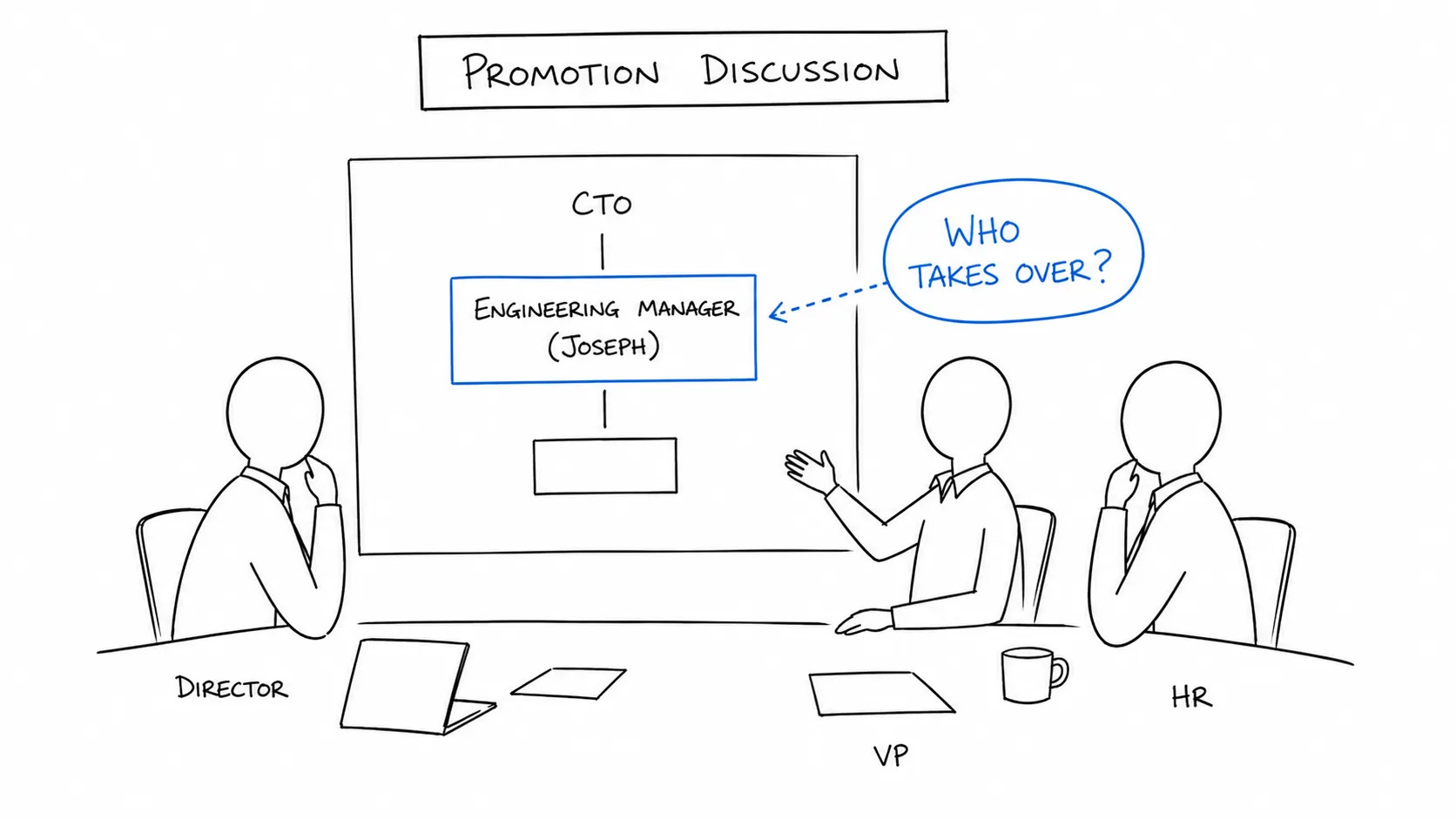
This doesn’t mean becoming replaceable because you’re average.
Quite the opposite.
You still have to become exceptionally good at what you do. In fact, the better you become, the more important it becomes to share what you’ve learned. You can’t teach what you don’t know.
The goal isn’t to become replaceable because you’re ordinary.
The goal is to become replaceable because you’ve multiplied your knowledge through other people.
Organizations don’t grow because they have indispensable people. They grow because those people build others who can carry the work forward.
The goal isn’t to become impossible to replace. The goal is to leave every role stronger than you found it, so that when the next opportunity comes, your organization can move you with confidence instead of keeping you exactly where you are.