

Early in my career, I thought I knew how to build a successful career. Become the best programmer I could be.
It seemed obvious. If I became technically better than everyone around me, better opportunities would naturally follow. Promotions, bigger projects, and better pay would simply be a reward for becoming a stronger programmer.
Looking back over thirty years, I think I was asking the wrong question. I didn’t need to become the best programmer. I needed to become more valuable.
Those sound like the same thing, but they are not.
In India alone, there are millions of software professionals. Every year, thousands more join the industry. Even if you become exceptionally good at a particular language, framework, or platform, there will always be many others with similar technical skills.
Technical excellence is still essential. It is the foundation of our profession. But I no longer believe it is enough to build an exceptional career.
Over the years, I noticed something interesting.
The people who kept getting pulled into the important meetings weren’t always the strongest programmers. They were the people who could sit with a customer, understand the business problem, discuss the technology, and then come back and explain it clearly to the engineering team.
They could move comfortably between different worlds.
Years later, I came across Scott Adams’ idea of a talent stack. He describes how combining several complementary skills can make you more valuable than trying to become the very best at just one.
His idea gave a name to something I had already been experiencing.
Technology remained my foundation. Everything else became a multiplier.
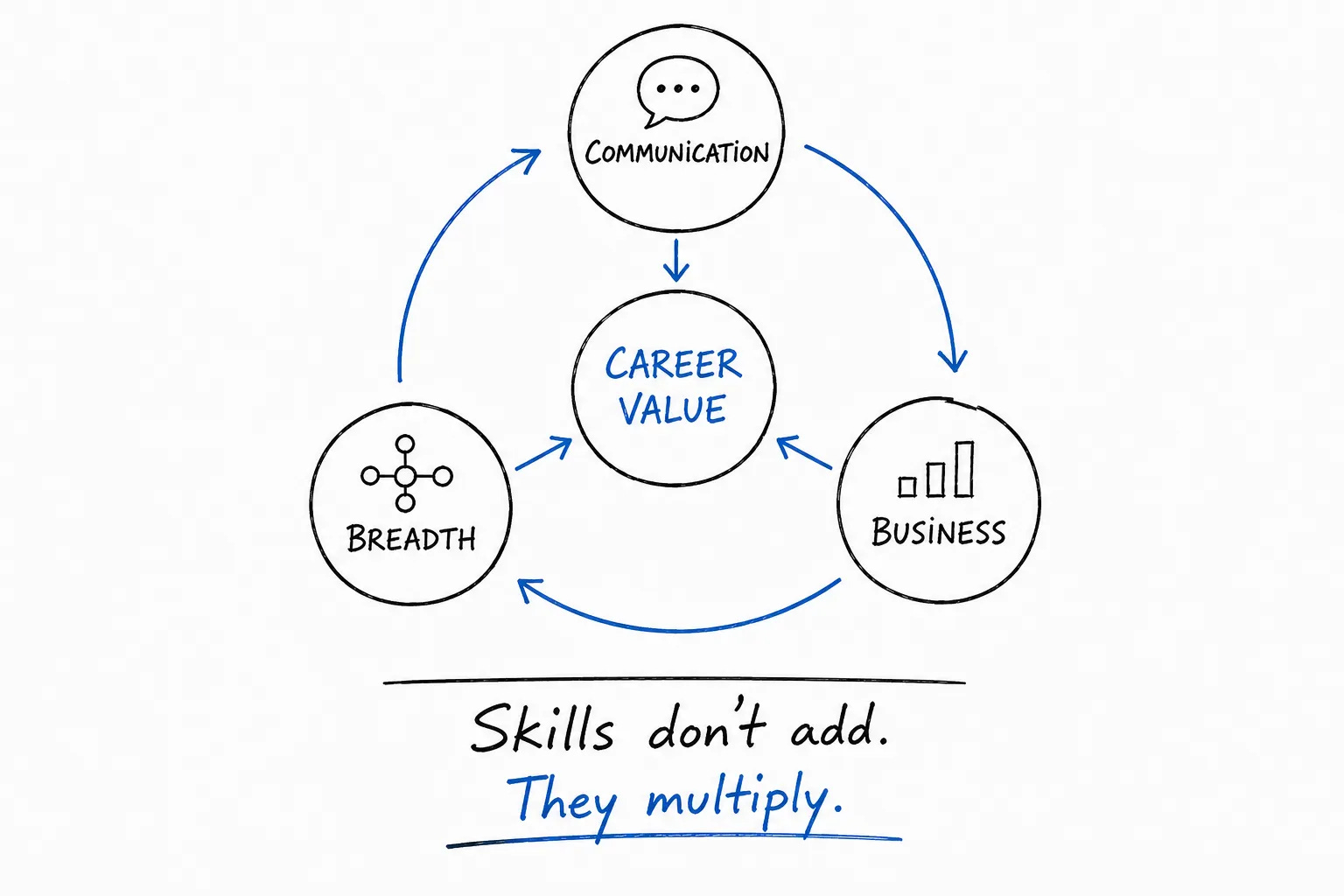
The first multiplier was breadth. While I developed deep expertise in a few areas, I also tried to understand the rest of the stack. Front end, back end, databases, cloud, mobile, architecture—I didn’t need to master every one of them, but I wanted to understand how they fit together. That made it much easier to have meaningful conversations across teams.
The second multiplier was business. I became curious about how companies actually worked. What increased revenue? What improved profitability? Why did one project get approved while another was rejected? How did sales, marketing, finance, and operations think about success? The more I understood the business, the better my technical decisions became.
The third multiplier was communication. I learned to explain technical ideas in language that business people could understand. I learned to listen carefully to customers, understand the problem they were really trying to solve, and translate that into something my engineering teams could build. I also learned to explain technical constraints without hiding behind technical jargon.
As those skills came together, people started calling me for different reasons.
Sales teams wanted me on customer calls because I could discuss both business and technology. Engineering teams relied on me because I could explain what the customer actually needed. Business leaders trusted me because I understood the commercial side as well as the technical side.
That’s when I realized these skills weren’t simply adding to my career. They were multiplying the value of the technical skills I already had.
That multiplication opened doors I had never planned for. It led me into government consulting, customer-facing roles, public speaking, leadership, and eventually the CTO role.
None of those opportunities came because I became the best programmer. They came because programming was no longer the only thing I brought to the table.
I no longer think the goal of a technology career is to keep adding technical skills forever.
The goal is to build a combination of skills that makes your technical expertise more valuable every year.
Keep building your technical foundation. Understand business. Learn to communicate clearly. Each new skill doesn’t replace the previous one. It multiplies it.
I never became the best programmer.
I simply became a programmer whose value kept growing because every new skill multiplied the ones I already had.
Skills don’t add. They multiply.