

One of the most useful pieces of leadership advice I ever received came when I became a junior project manager.
My manager said, “You have to learn to deal with ambiguity.”
At the time, I did not understand what he meant. I had come from a software engineering background, where ambiguity usually meant something had gone wrong.
As a developer, I lived in a world of clarity. The program either worked or it did not. The output either matched the specification or it failed. Computers reward precision, deterministic behaviour, and binary logic. That was the way I had been trained to think.
So when I heard that advice, I dismissed it as one of those management phrases that sounded important but did not mean very much.
I was wrong.
Over the years, I realised that this may be one of the most valuable leadership lessons I have learned.
The first place I saw it was in project planning.
Suppose you are planning a project that will run for a year. You gather requirements, estimate effort, identify risks, and prepare a detailed plan. Even after doing all that work, you still do not know what the next twelve months will bring. A key engineer may resign. Someone may fall sick at a critical stage. A third-party vendor may miss a delivery. The customer may change priorities halfway through the project.
None of these events are unusual. They are simply part of reality.
A project plan is not a prediction of the future. It is the best decision you can make with the information available today. Good project managers know the plan will change. They still make the plan because moving forward without one is worse.
Hiring taught me the same lesson.
You can interview a candidate several times, assess technical skills, evaluate cultural fit, and check references. Even then, you can make the wrong decision. Sometimes the person turns out to be different from what you expected. Sometimes life changes around them. A family emergency, an illness, or an unexpected opportunity can completely change the outcome.
The uncertainty never disappears, yet the hiring decision still has to be made.
As I moved into leadership roles, I realised that ambiguity was no longer an occasional part of my work. It had become the work itself.
Today, as a CTO, much of my day is spent making decisions with incomplete information. A prospect asks a question during a sales call that nobody prepared for. You have to think on your feet and keep the conversation moving. A production issue is escalated before anyone knows the root cause. The person who was supposed to present to a customer suddenly becomes unavailable, so you step in. Every day brings situations where waiting for complete information is simply not an option.
That changed the way I think about planning.
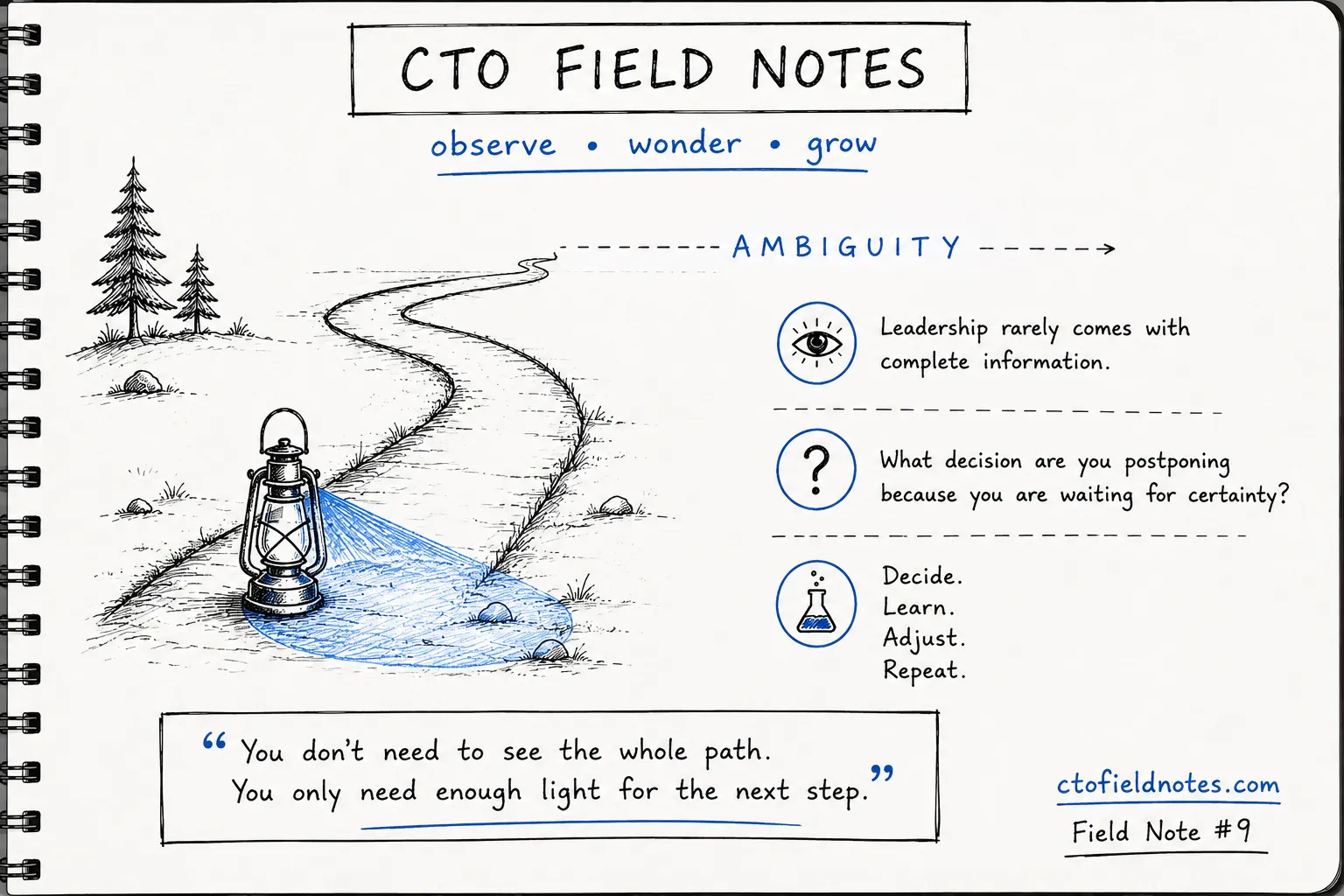
I no longer think in terms of fixed plans. I think in terms of experiments.
I gather data. I form a hypothesis. I try something. If the evidence supports it, I continue. If it does not, I change direction and learn from the result.
Leadership often looks less like executing a perfect plan and more like running a series of thoughtful experiments.
The obvious question is whether you can become better at dealing with ambiguity.
I think you can.
The first step is to expand your capability.
Take on hobby projects that are different from your day job. Volunteer in professional associations. Speak at conferences. Put yourself in situations where you have to learn quickly and adapt. I would also add one more habit that has helped me over the years: read literature.
Engineering trains us to think in binaries. Literature trains us to understand people.
The best characters are rarely completely right or completely wrong. They are complex. They have strengths, weaknesses, contradictions, and motives that change over time. The more you read, the more comfortable you become with people and situations that do not fit neatly into categories. Leadership is full of those situations.
As your capability grows, your confidence grows with it. Ambiguity becomes less intimidating because you trust yourself to find a way through.
The second step is to practise uncertainty in small ways.
Our lives are full of tools that remove uncertainty. They are useful, but they also mean we get fewer opportunities to practise dealing with it.
Every now and then, drive without Google Maps. Explore roads you have never taken before. When you are bored, resist the urge to reach for your phone immediately. Let your mind sit with the uncertainty instead of filling every empty moment.
These are small exercises, but they teach your brain an important lesson. Uncertainty is not the same as danger. Most of the time, you can figure things out as you go.
Looking back, I think my manager understood something that I had not yet experienced.
As engineers, we are trained to remove ambiguity. As leaders, we are expected to make decisions in spite of it.
The higher you grow, the less certainty you have. You rarely have all the information. You rarely have all the time you want. Yet the decision still has to be made.
Leadership is not about having all the answers. It is about making the best decision you can before all the answers exist.
Joseph, this resonates deeply; the shift you describe from deterministic binary logic to embracing ambiguity is exactly the struggle many engineers face today when transitioning into the AI space. Just as leadership requires experimenting with incomplete information, working with non-deterministic AI models forces us to let go of rigid "if-then" safety nets. Great insight on treating these ambiguous challenges as thoughtful experiments rather than fixed plans.