

The challenge of a CXO role is that it requires two seemingly opposite capabilities at the same time.
You need to see the future. And you need to deliver the present.
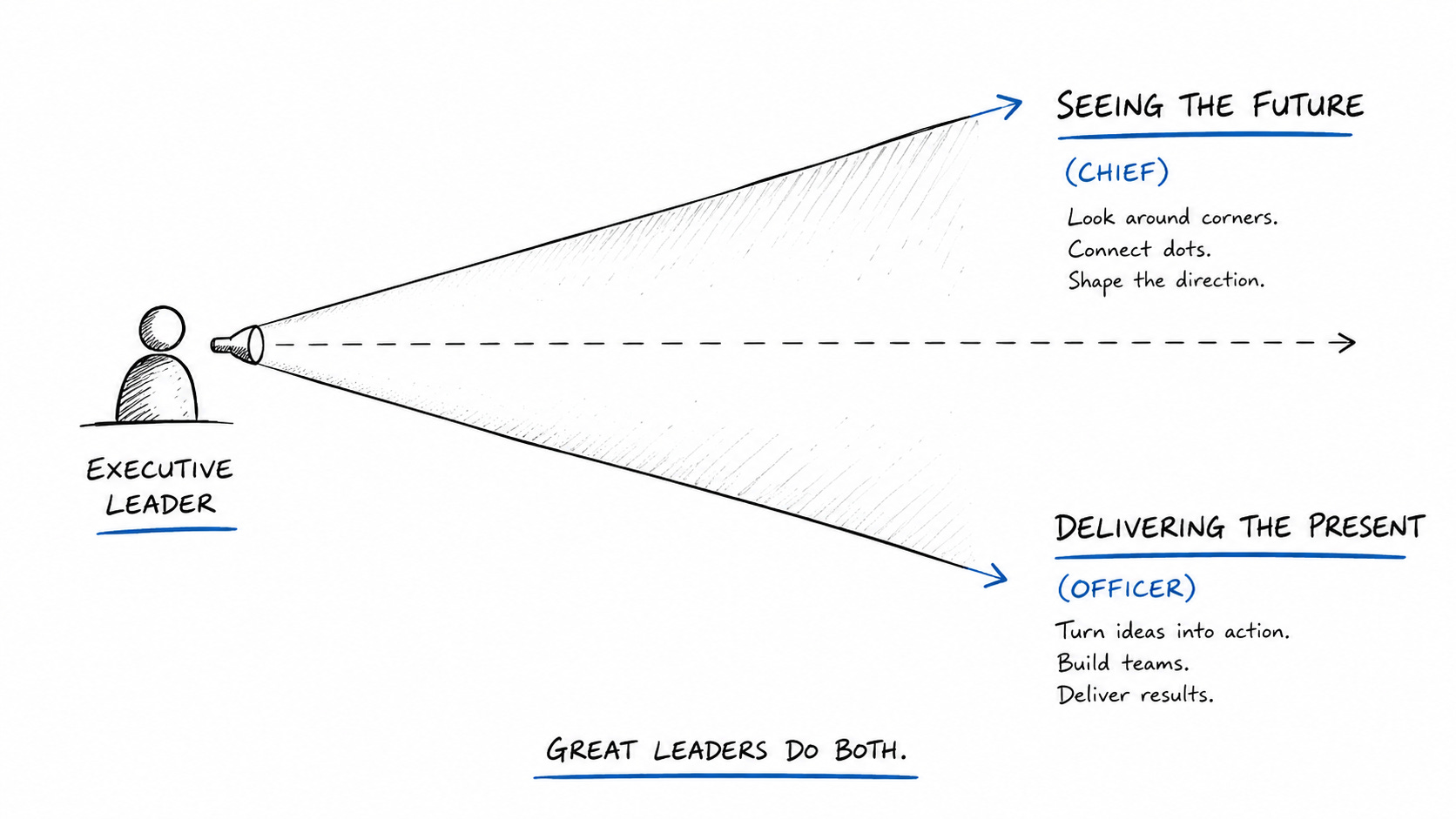
Most leaders are naturally stronger at one than the other.
Every executive title has two common words: Chief Technology Officer, Chief Financial Officer, Chief Operations Officer, Chief Sales Officer.
Most people focus on the second word. Technology. Finance. Operations. Sales.
That makes sense. Most leaders spend years developing expertise in their chosen function. It is often that expertise that earns them a seat at the executive table.
After spending a few years in the C-suite, I have come to believe the more important words are the other two.
Chief and Officer.
When I first became a CTO, I assumed technology would occupy most of my attention.
It certainly occupies some of it.
What surprised me was how often the real challenges had little to do with technology itself.
The difficult questions were usually about the future.
Where should we place our bets?
Which opportunities should we pursue?
What capabilities would matter three years from now?
What should we stop doing so we could focus on what matters?
Those questions led me to a deeper question.
What exactly does it mean to be a Chief?
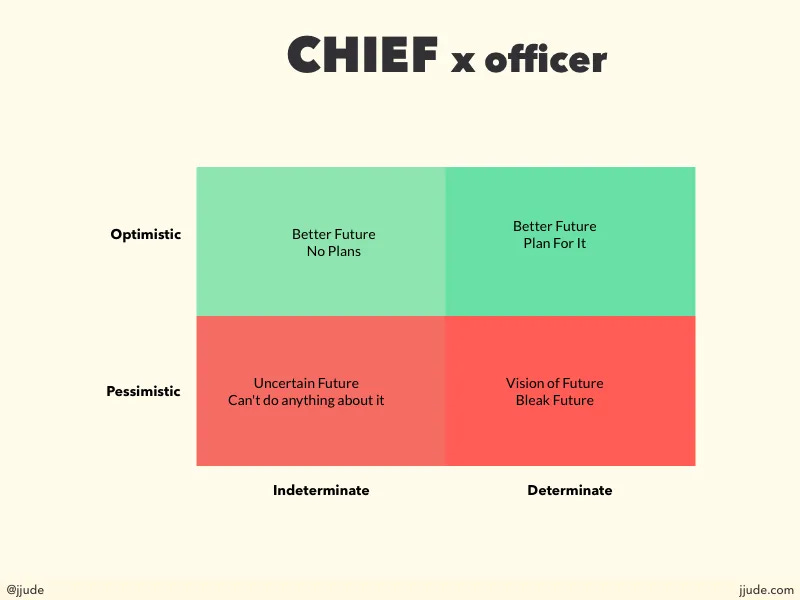
Peter Thiel describes four views of the future. Some people are optimistic. Some are pessimistic. Some believe the future can be shaped. Others believe it simply unfolds.
The people who stand out are determinant optimists. They have a specific view of a future they want to create.
John F. Kennedy did not simply say that space exploration was important. He declared that America would put a man on the moon and return him safely to earth before the decade ended.
Jeff Bezos wrote in 1997 that online commerce would eventually accelerate discovery through personalization.
Elon Musk laid out a sequence of steps that would lead to affordable electric vehicles.
Whether you agree with them or not, these leaders had something in common.
They saw a future before others could see it.
That is the work of a Chief.
A Chief looks around corners. A Chief connects dots. A Chief reads broadly and thinks across domains. A Chief develops a point of view about where the organization should go.
But that is only half the title.
The second half is Officer.
An Officer is responsible for results. An Officer turns ideas into action. An Officer allocates resources, removes obstacles, builds teams, and creates accountability.
Without Officers, visions remain presentations, strategy documents, and keynote speeches. Nothing changes until somebody does the hard work of turning an idea into reality.
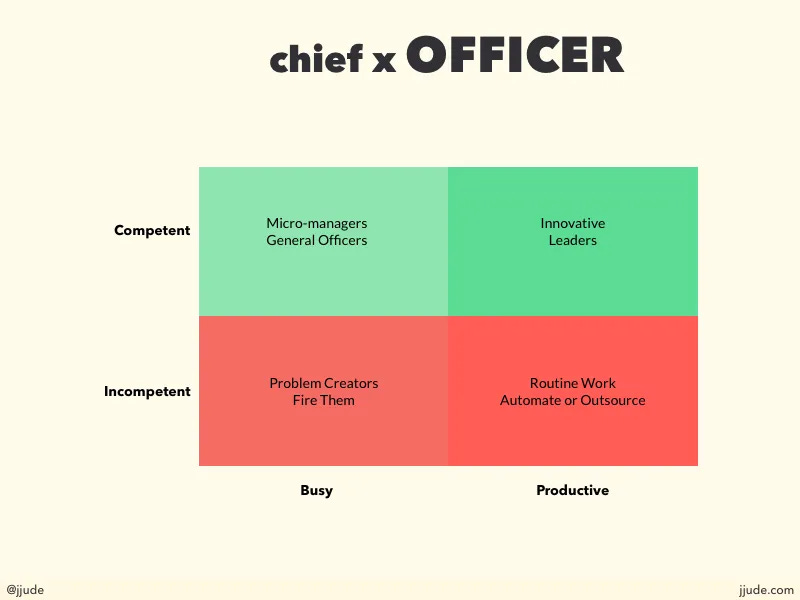
What I have observed is that leaders often become trapped on one side of the title.
Some become all Chief. They talk strategy. They discuss industry trends. They attend conferences and paint compelling pictures of the future. But little changes inside the organization.
Others become all Officer. Their calendars are full. Their inboxes overflow. They spend their days solving problems, responding to issues, and moving from meeting to meeting. But they rarely lift their heads long enough to ask where the organization is actually headed.
One group has direction without progress. The other has progress without direction.
Neither is enough.
I see this tension play out almost every day in conversations about AI.
It is easy to paint a picture of the future:
The future of commerce is agentic commerce.
AI agents will transform customer service.
Software development will become AI-assisted.
Search will become conversational.
Workflows will become autonomous.
The difficult part is making any of it real. The vision may be clear, but reality has a way of showing up. Budgets are limited. Teams need training. Security and governance concerns need answers. New technology must coexist with old systems. And business leaders still expect results this quarter, not three years from now.
Seeing the future is exciting. Delivering it is hard.
That is why the best executives I have observed seem comfortable living in both worlds.
They can think strategically and act operationally. They are simultaneously visionaries and operators.
This is the defining challenge of executive leadership. Not choosing between vision and execution. Holding both at the same time.
To borrow from a popular saying, vision without implementation is an illusion. The opposite is equally true. Implementation without vision is one of the surest paths to defeat.
Every executive title contains both a C and an O. Most people spend their careers mastering one. The challenge is learning to master both.