

Five years ago, I wrote a post called “A Roadmap For Developers.” It laid out the path from writing a first API to sitting in the CTO office as a layered pyramid: Design, Build, Scale, Platforms. Structured thinking and communication cut across all four layers.
The thesis was simple: start by building things, then learn to design them well, then learn to scale them, then learn to think about platforms instead of projects. A developer who did all of that while learning to think clearly and communicate well would find the CTO office was the natural destination.
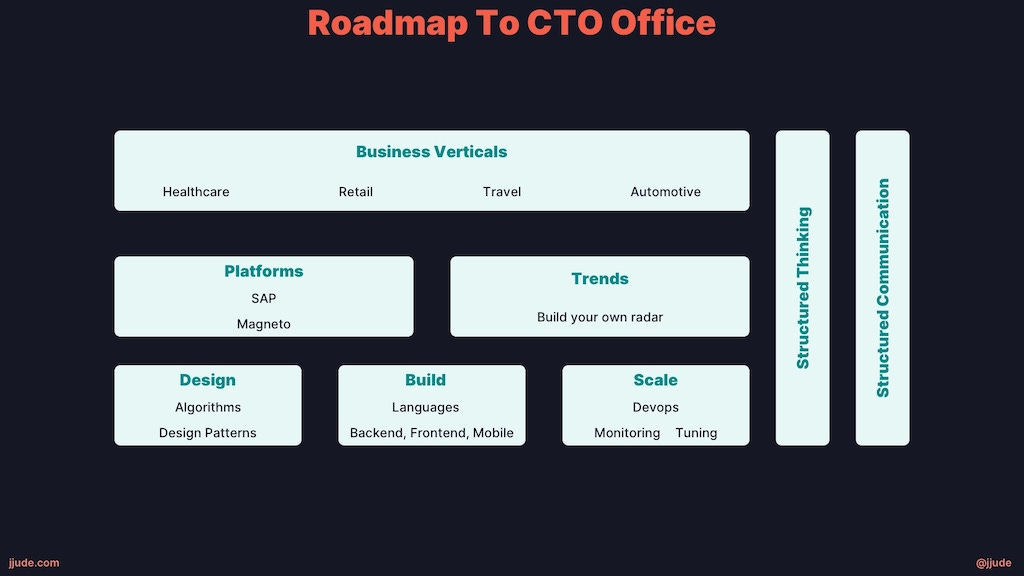
GenAI and agentic coding has impacted this roadmap. This post is an attempt to identify skills that still matter.
The market today says coding is dead. Developers should become prompt engineers. The old roadmap is obsolete. I have watched agents write code, deploy services, debug errors, and generate tests. I understand why the conclusion feels obvious. But the conclusion is wrong. Every layer still matters. What shifted is the work inside each layer.
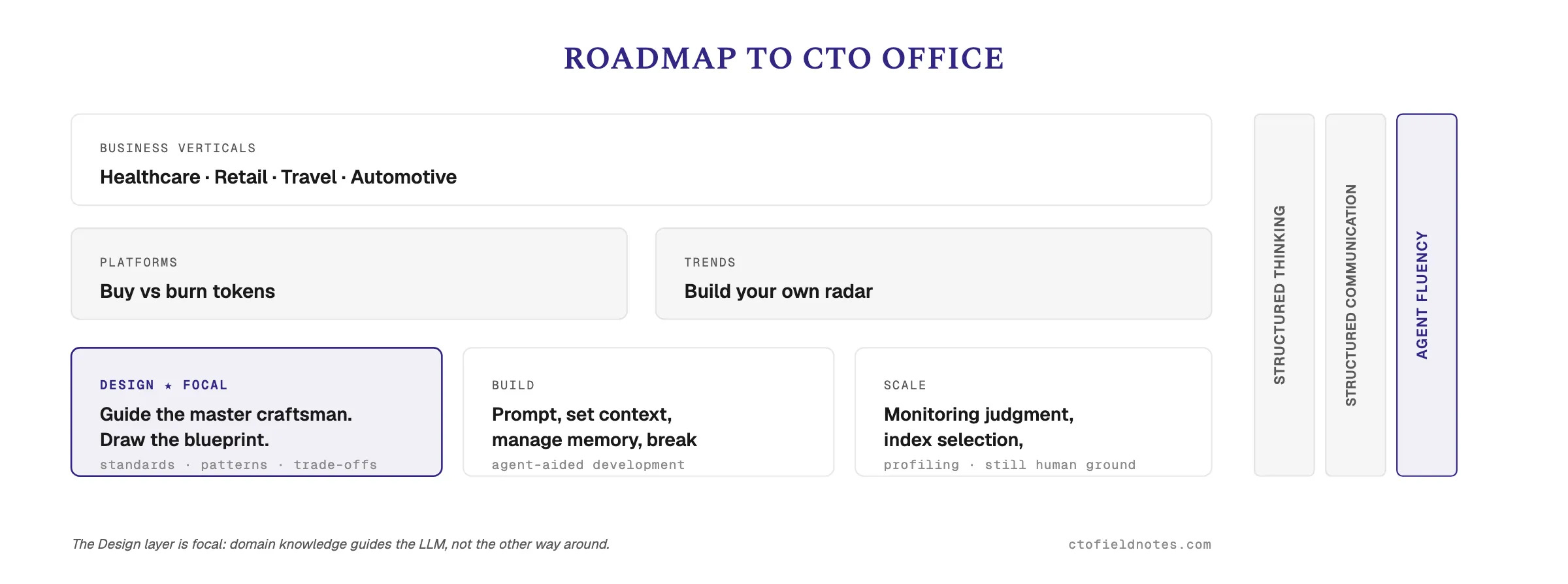
The Build layer has not disappeared. It has changed shape. Old Build meant hand-coding every component, every endpoint, every test. New Build means prompting, setting context, managing memory across sessions, and breaking large problems into agent-sized chunks. The builder is becoming a director. But a director who has never laid bricks gives bad direction. The build skill is still essential. It is just taking a different form. I will write more about this in the next post.
The Design layer matters more now, not less. Especially for enterprise applications.
Early in my career, I was computerising a hospital department. I had a cyst. I asked a surgeon-intern what I should do. She grinned and said, “Operate.” It was a joke, but it made a point I have never forgotten: ask a surgeon, get surgery.
The same is true of an LLM. Ask it to build an application without context, and it will give back something. It might build for a complex user scenario when a simple one would do. It might build for a demo when the need is production-ready. Either way, it builds what was asked for, not what was needed. Nobody can guide what they do not understand. Design knowledge is what lets an engineer guide the master craftsman: coding standards, design patterns, monolith versus microservice, component decomposition. The LLM executes. The architect still draws the blueprint.
The Scale layer remains firmly in human hands. Agents help with DevOps scripts, monitoring configurations, index suggestions. But understanding what to monitor, which indexes matter, how to profile functions, and how to tune for growth: these judgements are not automatable yet. The tools changed. The thinking did not.
The Platforms layer is exactly what I said in 2021. Build versus Buy is now Buy versus Burn Tokens. Any serious business owner still defaults to buying over building. Platforms win because they compound. No revision needed.
Three skills cut across all four layers. In 2021, I named two: structured thinking and communication. I positioned them as late-career additions, things to pick up after proving technical competence. That was a mistake. They belonged at every level from the start. In 2021, these skills differentiated a developer from other developers. Today, they also differentiate a developer from an agent.
The third cross-cutting skill is something I have started calling agent fluency. It is not prompt engineering. It is knowing how to set context, manage memory across sessions, break large problems into agent-digestible pieces, and evaluate what the agent produces. It is the skill of working with agents the way a senior engineer works with junior engineers: clear direction, clear boundaries, clear evaluation criteria. This skill did not exist on the 2021 roadmap because it did not need to. Today, it cuts across every layer, from build to platforms.
The speed of change makes it impossible to track everything across tech, e-commerce, design, and adjacent domains. I built SophAI Radars to solve this. Pick your domains, and it turns hundreds of sources into editorial briefs readable in three minutes. It is how I stay current without drowning.
The pyramid still stands. What changed is who, or what, does the work inside each layer. This is how the roadmap looks like now. Let me know if I missed anything. I’m still figuring this out myself.
Field Notes
Observation
Every layer of the roadmap still matters. What shifted is the nature of the work inside each layer, and the skills needed to do it.
Question
Which layer of your work has shifted most in the last two years, and which have you neglected?
Experiment
For one feature this week, direct an agent with explicit design constraints: patterns, standards, component boundaries. Do not just describe what to build. Compare the output.
Nicely articulated 👍