

Looking back on my career, I have become convinced that career growth depends less on talent than most people think.
Talent matters. Skills matter. Hard work matters.
But there is something else that quietly shapes a career long before talent has a chance to prove itself.
It is the set of beliefs we carry about ourselves, other people, and what is possible.
The interesting thing is that these beliefs often remain hidden. In normal day-to-day work, they are difficult to see. They usually reveal themselves when an opportunity appears, when pressure arrives, or when we are asked to step outside our comfort zone.
Many years ago, I was managing a group that provided L2 support for several applications used by a large American insurance company. We worked night shifts to align with US business hours.
One day, a ticket arrived and the employee responsible for handling it came rushing to me.
He explained that when he added the digits of the ticket number together, the total came to eight. For him, eight was an inauspicious number. It was the first ticket he was handling, and he did not want to acknowledge it.
I remember telling him that failing to acknowledge the ticket within the required time would be far more inauspicious than the number itself.
The ticket was not the real issue. The issue was the belief behind it.
What we believe affects how we respond when opportunities and responsibilities show up. Sometimes the opportunity is obvious. Sometimes it is disguised as a problem that nobody else wants to handle.
Over the years, I have seen many versions of this.
But the most important example was my own.
For a long time, I believed I was an introvert. The problem was not that I was introverted. The problem was the meaning I attached to that label.
I convinced myself that sales was not for me. Customer conversations were not for me. Public speaking was not for me.
Without realizing it, I had built a fence around my own career.
The opportunities were there, but I had already decided they belonged to someone else.
Over time, through reading, conversations, training, and experience, that belief started to change.
Today, I am not a salesperson.
But I enjoy customer conversations. I enjoy helping sales teams. I enjoy presenting ideas, speaking at events, and explaining technology to clients and prospects.
The opportunities did not suddenly appear. They were always there. What changed was the way I saw myself.
The biggest obstacles in my career were technical. Most of the technologies I learned eventually became obsolete anyway.
The bigger obstacles were often the beliefs that told me what I could or could not do.
Every time one of those beliefs changed, new opportunities appeared.
Another experience taught me a different lesson.
Early in my career, I joined a new project and was assigned to work with a colleague who was supposed to help me understand the system.
He spent about twenty minutes showing me a few screens and giving me a quick overview. Then he was done.
I walked away frustrated. I assumed he did not like me. I assumed he did not want to share information. I assumed he saw me as competition.
Later, while having coffee with a friend, I mentioned the situation.
My friend laughed.
“Joe, you’ve completely misunderstood him. He’s new to the company, new to the city, and not comfortable speaking English. Give him some time.”
My interpretation had been completely wrong.
Over time, that colleague and I became very good friends.
That experience taught me that beliefs do not only shape how we see ourselves. They also shape how we see other people.
And when we misread people, we often miss opportunities to learn from them, work with them, and build relationships that could help us grow.
One conversation changed my thinking more than any book or course.
For many years, I struggled with an inferiority complex. A close friend who knew me well finally said something that stayed with me.
“Joe, you are neither inferior to anyone nor superior to anyone. God has created all of us equal.”
It was a simple statement. But it changed how I viewed myself and others.
After that conversation, I stopped comparing myself with others. I became more willing to take on responsibilities that I would previously have avoided.
Slowly, I became comfortable speaking in front of groups, engaging with customers, leading teams, and stepping into situations that once felt intimidating.
The belief changed first. The skills came later.
Over a long career, I have seen people with extraordinary talent remain stuck.
I have also seen people with average talent grow far beyond what anyone expected. The difference was often not intelligence, education, or technical skill. The difference was how they viewed themselves and the opportunities around them.
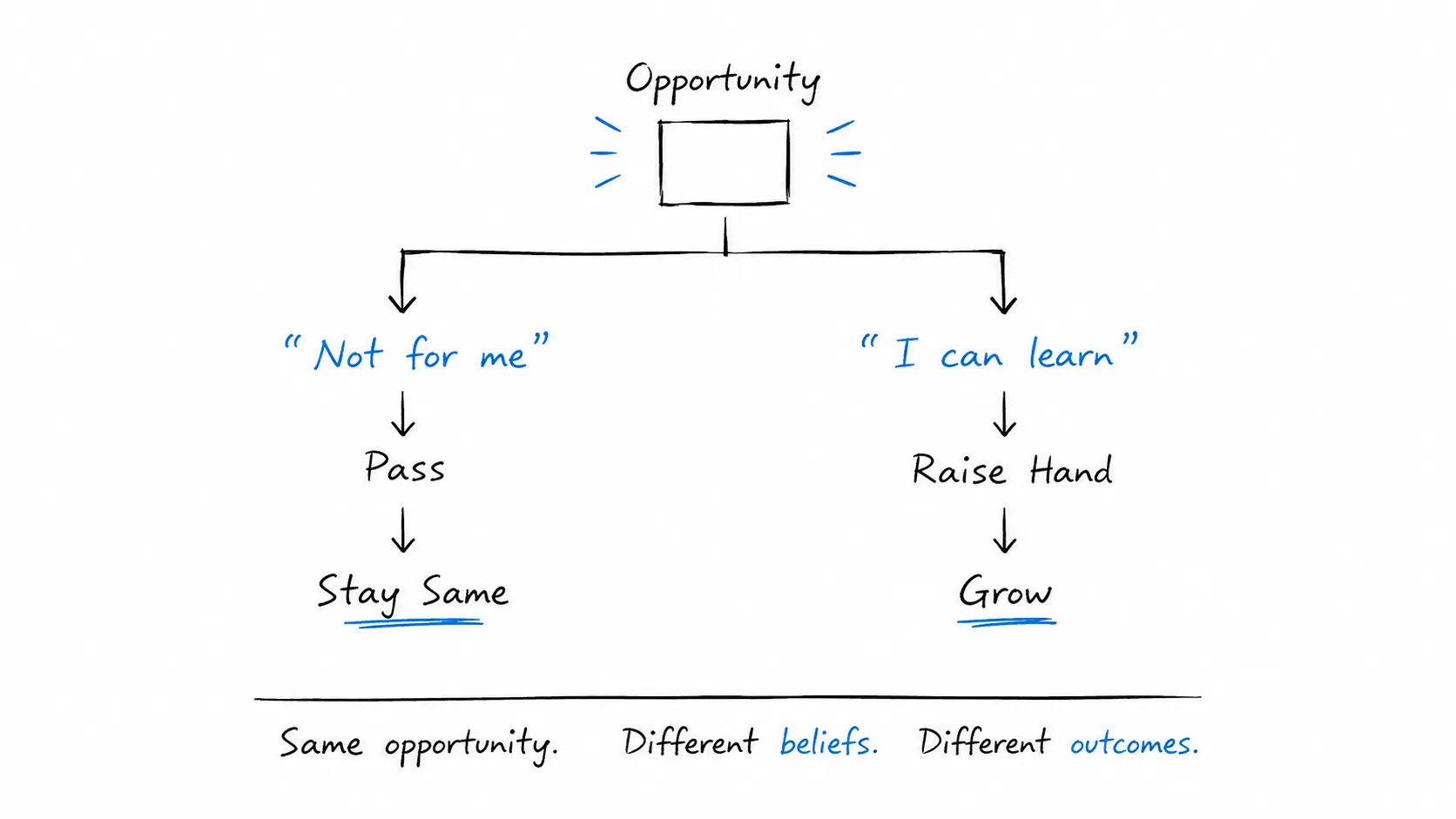
When an opportunity appeared, some people immediately found reasons why it was not for them. Others raised their hand and figured things out along the way.
The second group usually grew faster.
Not because they were more talented. Because they were less limited by the beliefs they carried.
I am reminded of Paul’s words about being transformed through the renewing of our minds.
Many of the beliefs that shape our careers come from family, culture, past experiences, fears, failures, and assumptions we have never taken the time to examine.
Yet those beliefs quietly influence our decisions every day. They influence which risks we take. Which opportunities we pursue. Which people we learn from. And ultimately, how far we grow.
Most opportunities do not arrive with certainty attached to them. They usually arrive disguised as responsibility, discomfort, risk, or change. Whether we step forward or step back often depends on what we believe.
And over time, what we believe may do more to determine our career growth than our talent ever will.
Very true, it's a mindset game!