

The phrase work-life balance has become part of everyday language. It suggests that work and life sit on opposite sides of a scale. If one side goes up, the other must come down. More work means less family. More family means less career.
That idea assumes life is mostly a series of trade-offs.
Ryan Holiday shares advice from Austin Kleon that captures this way of thinking:
Work. Life. Scene. Pick two.
Work is how you earn a living. Life is your family and close relationships. Scene is everything else—parties, dinners, networking events, and the activities that fill social media feeds.
There is some truth in this. Time is limited. Every commitment leaves less time for something else.
But I think time is only part of the story.
Jeff Bezos offers a different metaphor.
It’s a flywheel, not a balance.
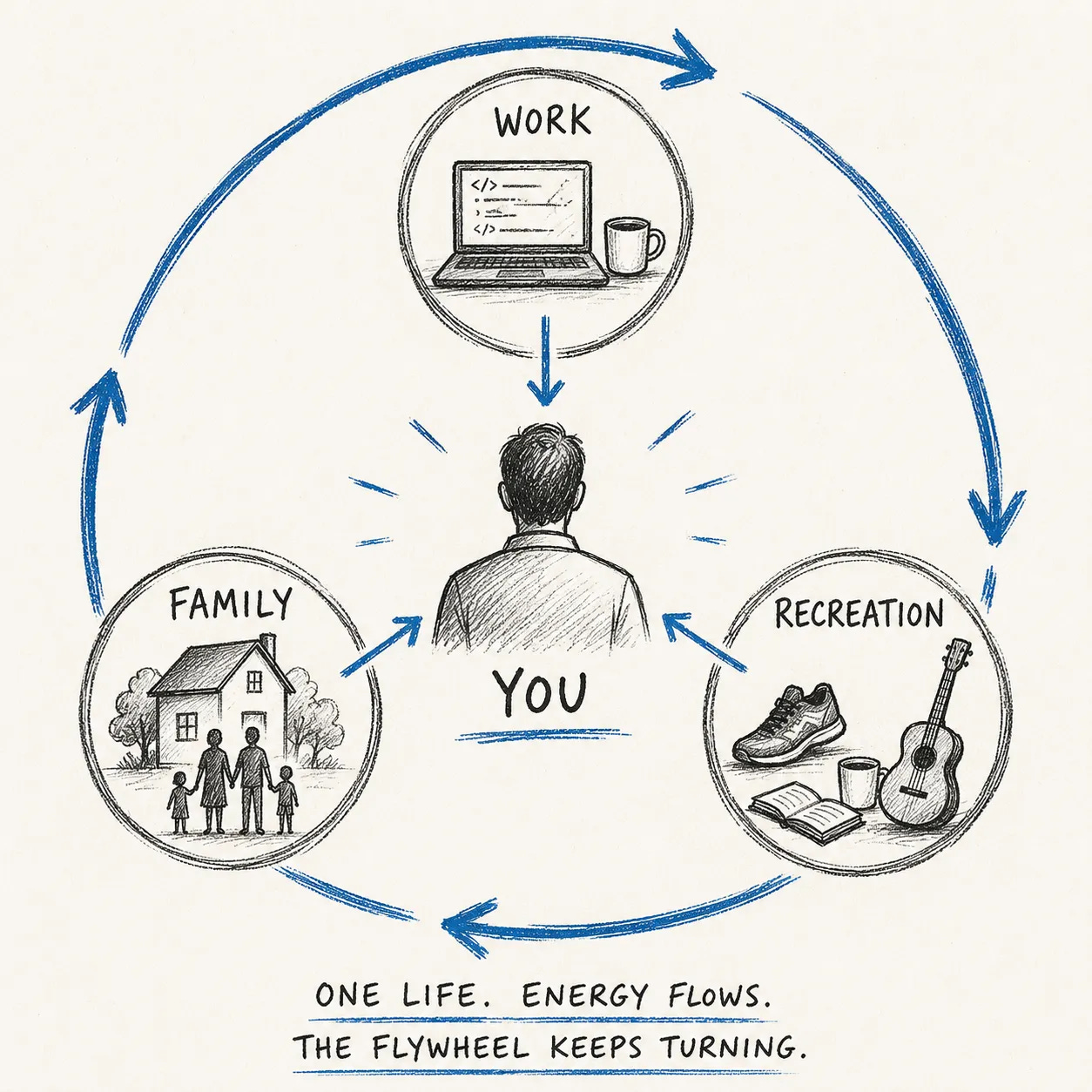
He explains that when work energizes him, he becomes a better husband and father. When life at home is good, he becomes a better leader at work. Each part strengthens the others instead of competing with them.
That idea has matched my own experience far more closely.
I’ve been fortunate that both my work and my family have been sources of energy. They rarely compete with each other. Instead, they reinforce each other. There are also times when a meal with close friends or a good conversation leaves me equally refreshed.
The common thread isn’t whether an activity belongs to work, family, or leisure.
The common thread is whether it gives energy or takes it away.
A job that constantly drains you eventually affects your relationships. A difficult home life eventually affects your work. Even recreation is not always replenishing. Some activities leave you more tired than when you started.
Perhaps the real question is not how to balance our lives.
Perhaps the better question is this:
What keeps my flywheel turning?
The activities will be different for each of us. For one person, it may be jogging. For another, it may be reading, spending time with family, serving in a church, or meeting close friends.
The important thing is not the category.
It is whether that activity generates enough energy to make every other part of your life better.
I no longer think of work, life, and fun as competing priorities.
I think of them as parts of the same flywheel.
When they generate energy, they reinforce one another. When they drain energy, the whole system slows down.
A long life is built not by separating and balancing work and life, but by integrating the two and filling it with the people and activities that keep the flywheel moving.